Lightency Documentation


  • Created: 6 December, 2022
  • Update: 9 Avril, 2023

If you have any questions that are beyond the scope of this documentation, file, Please feel free to email via the contact section .


Introduction

Lightency in Nutshell :

Lightency is a web3 energy platform , it enables negative carbon impact utility token, allows community governance to holders and traceability of energy investment as well as green energy production. Lightency’s model allows for regions lacking renewable electricity access to create self-sustainable communities able to generate and consume energy dynamically. Furthermore, Lightency transforms carbon offsets into investable assets through state-of-the-art Energy Attribute Certificates.
Lightency is a multi-faceted holistic Web3 platform that allows the utilization of the blockchain technology to maximize and optimize energy distribution and production. Additionally, Lightency makes use of Decentralized Finance to provide an alternative funding scheme for green energy projects. Lightency’s DeFi solution additionally offers crypto enthusiasts from yield farmers to VCs the opportunity to make a green impact and offset their carbon footprint while making attractive returns.

Lightency, a Utility Token ?

Lightency token is packed with diverse utilities, including but not limited to the following:

To Green Energy Investors Green energy investors will utilize the token to invest in Lightency’s Energy Fund, and as a result be offered exclusive access to attractive returns and an active role in the governance of the fund and the choice of its investments.
Reward Partners, affiliates, and stakeholders will be rewarded with vested tokens according to the allocation and schedule of the tokenomics model.
Lightency DAOs The Lightency DAOs members have a fundamental role in the roadmap and decisions of the project. The token in this case will be utilized to submit, vote, and reject proposals.
Swap The Lightency token is used to auto-convert to desired tokens prior to cash-out procedure.
Stake Lightency offers diverse staking packages depending on the lock period. Yield farmers will stake Lightency tokens to get attractive returns and make a green impact at the same time.
Energy certification Households and organizations will have the opportunity to acquire energy attribute certifications to offset their carbon footprints.
Powerchain Grid operators will use Lightency tokens to purchase the powerchain service.

Token economy

Lightency is a utility token that allows holders to benefit from all the features in the platform while incentivising the early adopters, thus this token gains in value through its adoption rather than speculation and high dependency on the evolution of the crypto market. Avoiding the volatility of the crypto market is key to sustaining user loyalty and creating organic growth.

Lightency Users:

Let's identify in high level the Persona of Lightency users
  1. Crypto VCs :
    Crypto Investors who look to Medium-long term investment will be able to invest in Green Energy projects through the energy fund as well as earn attractive passive income and participate in LightencyDAO.
  2. Yield Farmers/ Crypto VCs/ Retail Investor :
    Crypto enthusiasts looking to generate attractive returns while making a green impact
  3. Vesters :
    Crypto enthusiasts looking for exclusive packs while locking tokens for a considerable period
  4. Organisations :
    Any Organization that is looking to use the energy certification platform to certify green energy production, or to buy and sell a green energy certificate.
  5. Utilities & DSO* :

    *DSO : are the entities responsible for distributing and managing energy from the generation sources to the final consumers Typically.

    Energy distributors who have interest to incentivise their customers to produce local green energy. PowerChain allows an energy marketplace where local producers can provide their energy exceedance in a local community marketplace.

Token model

Lightency token should be low in volatility, non-inflationary. The token price should grow proportionately with Lightency token utilities, which is directly related to the growth of the active users. The token bonding curve (BC) is an Aristotian[1] view of money, in the sense that each token issued is backed by a stable store of value (fiat or stablecoin). This ensures less information asymmetry and reduces the volatility of the asset. Creating a fixed supply with no underlying asset follows the Platonic Vision.

Bonding curve

  1. How does it work? :
    A bonding curve contract issues its own tokens through buy and sell functions. To buy tokens, you send cryptos/fiat to the contract which swaps these assets to stable coins and issues Lightency tokens following the value of the cryptos/fiat received.[2]
  2. The Sell function works in reverse:
    First you provide the bonding contract with permission to take the amount of tokens you want to sell and then you trigger the function to take those tokens from you. The contract will calculate the current average selling price and will send you the correct amount and burn the tokens sold. Token price is then updated following its relation with the token supply.
    Advantages Disadvantages
    The advantage of the bonding curve is that it ensures organic growth. Indeed, the price of the token only increases according to the increase in demand. This prevents us from phases of speculative bubbles, leading in most cases to extreme volatility. The disadvantage of the bonding curve is that it allows for printing and burning to occur forever, they allow for supply to grow without bounds
    Mitigation: Alternatively, some bonding curves hard-code a cap to the number of prints that can exist in the market. Hard coding a hard cap to no longer have the supply infinity constraint will ensure that the price of the token does not become stationary. Once the hard cap is reached, the token will then trade in the secondary market.
    The advantage with the reward system is that the dilution of the token's value is almost non-existent, and given the deterministic nature of the token's price, Lightency can estimate the price impact of the reward distribution. A disadvantage of the bonding curve, it flows from its nature, namely that each token is a standard of value. Rewards can only be distributed by collecting part of the profits generated from the activity within the Lightency ecosystem.
    Mitigation: Using an augmented Bonding Curve (ABC) allows implementing vesting mechanisms. Dedicating initial funds to buy tokens to charge the reward and incentive pools.

Price

The Price per token increases as the number of tokens issued increase.

For instance, a very simple version of the contract specifies that the price per token is equal to the number of tokens currently in existence. More specifically, to sell a token, the price is equal to the number of current tokens but to buy the price is equal to the number that will exist after you purchase. For instance, if there are 10 tokens in existence then selling 1 will earn you 10$. If you want to buy the 11th token, you’ll pay 11$ for it and so on.[2] -Buying slides you up the price curve and selling slides you back down. In the example above, if there are 9 tokens in existence then we know that buying another token will cost 10$. However, selling a token into the contract will earn us 9$. If I sell another token, it will earn me 8$. I could sell another 3 and be down to 5$. But then if I buy, it will push the price up to 6$ again. So the price adjusts dynamically.[2]

image

image

What happens if the price in the secondary market is different from the price on the Bonding Curve?


Arbitrage

Furthermore, thanks to its AMM nature, the Curve will also stabilize the prize all over the network. Even if the community creates additional exchange solutions for the token like a DEX pool, sudden price fluctuations will lead to arbitrage opportunities between them and the Curve that can be exploited by anyone therefore stabilizing the price no matter where the token is trading.[3]

Source : Click here


Lightency pillars

As the Bonding Curve contract is the only responsible for minting new tokens, we created pools owned by Lightency team stakeholders to interact with the Bonding Curve

The treasury

The Treasury is a contract that feeds the staking pool, the reward pool and the energy fund pool as well as the team pool

image

image


Energy fund pool

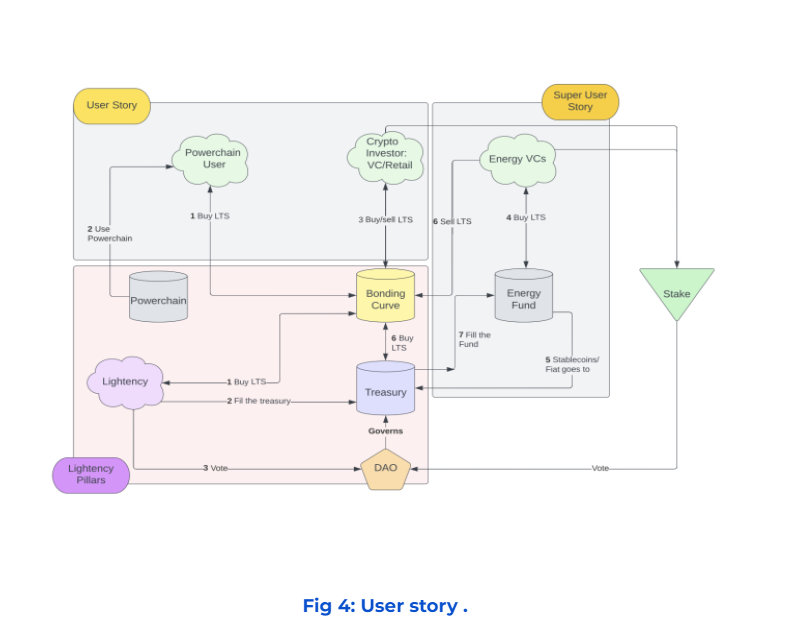
It is a pool dedicated to VCs to purchase Lightency tokens with a discounted price following a vesting period. This pool is governed by the treasury. This allows the treasury to govern the received funds and invest in the energy projects. As the token price can only increase with adoption, Lightency treasury buys a big portion of the token at the Bounding Curve launch. This figure below presents the initial scenario of the Token launch and the interactions between the different pillars.

User / System experience

In the next section we will explore the interaction between the treasury, the Dao, the energy Fund and the Bonding Curve. Also present on high level how the bonding curve interacts with a Buy and Sell Function, in this case with the Treasury but it's the same process with any user.

image


Staking

Implementing a staking mechanism is very important to decrease the circulating supply, have an overview of the big unstaking upcoming event in order to decrease any potential volatility in the token price. Staking will encourage users to not cash out but to lock the token in the platform to earn passive income.

image


Lightency DAOs

To browse more detailed documenation, clik on the : Lightency DAOs

Lightency is a platform that offers decentralized financial (DeFi) solutions, and it is built on the concept of decentralized autonomous organizations (DAOs). DAOs are a new way of organizing communities and making decisions, where the power to make decisions is distributed among all participants in a network.
In the context of DeFi, DAOs are becoming increasingly important because they allow for decentralized decision-making and governance. In other words, DAOs provide a way for the community to collectively manage and govern the DeFi protocol.
The Lightency DAOs are responsible for overseeing the development and governance of the platform. Participants in the DAO have the ability to vote on proposals related to the protocol's operation, such as changes to the code, allocation of funds, and protocol upgrades.
By leveraging the power of DAOs, Lightency is able to offer a more decentralized and community-driven approach to DeFi, which aligns with the core principles of the blockchain technology on which it is built.

Roles

  1. Council :
    Council members are whitelisted members.They are the most superior in the hierarchy . Only council members can add other council members . Council members are also the only members that can create a proposal. Council members can vote on proposals.
  2. Community :
    Community Members are the new joiner to the DAO only at one condition they must be stakers . Only stakers can join a DAO and become a community member. Community members can vote on the proposals listed by counsel members.

Proposals

The Proposals can be one of these types :

  1. Fund a Specific Pool :
    By specifying in the proposal the address of the pool that we want to fund
  2. Burrow :
    Burrow Stable coins from lending protocols.
  3. Delete a Member :
    A council member can create a proposal to delete a council member.
  4. Community Pool :
    is to decide on upcoming features, updates, and any strategic decision that can impact the economy of the token.

image


Energy Attribute Certification

Energy certification platform is a system for the issuance and management of Energy Attribute Certificates (EACs). EAC is an official document which guarantees that produced energy comes from a renewable source. There are different standards that regulate how data is stored and validated. In Europe, this document is called Guarantee of Origin (GO), in North America, it's called Renewable Energy Certificate (REC), and in parts of Asia, Africa, the Middle East, & Latin America the governing standard is International REC (I-REC). Standards do vary, but they all share the same core principles.
The main purpose of EACs is to act as an accounting vehicle to prove that consumed energy came from a renewable source. EACs are mostly used to address sustainability reports regarding Scope 2 emissions.

image


DAO oriented

As the users of the platform are organizations who have different policies and should interact with regulators and standardization bodies, the governance of the platform is composed of different DAO´s that interact with each others to track the energy produced and interact with the different stakeholders with a set of rules and standards that protect each institution.

Solution

The Key stakeholders are : organization & issuer, each organization can create Its DAO with predefined rules to allow access to its employee as part of this organization with a set of responsibilities. Same for the issuer, they can create their Dao and allow members to participate following predefined rules. The issuer DAO is used to enable issuers to mint EAC's upon request based on provided generation evidence by the organization. Besides just minting new EAC’s, the issuer DAO also ensures that the certificate lifecycle and organizations are always in compliance with the regulation. The exchange module is used to facilitate trading between buyers and sellers of EACs. The exchange module is built on the bases of the order book system where sellers post asks and buyers post bids. Once there’s a match based on EAC criteria and price the trade is executed. The UI module is the glue that connects all underlying modules and makes them accessible to the end-user. It’s also a demonstration of how easy it is to build an open, transparent, and regulatory compliant market for EACs around the world.

Powerchain

Powerchain is a decentralized energy management system that allows energy tokenization to better balance the grid and provide a transactive energy marketplace to increase energy efficiency for the grid operator and incentivise energy producers with a better monetisation. PowerChain is composed of 2 Modules ; Energy management system, and an energy market place. In figure 7 we explain the relation between PowerChain and an energy installation. The EMS is designed with a decentralized infrastructure and adopted from OpenEMS, a European energy software association.The energy marketplace is composed of 3 main algorithms that we will explore in the next sessions to maintain an efficient and autonomous marketplace.

image


Powerchain

  1. Description :
    The EMS has the role of maximizing the efficiency of the MG and optimizing the distribution of available production on the grid. This system communicates, in real time, with devices and services to collect data, perform analyzes and calculations, and execute control and processing algorithms. In other words, the EMS manages the energy flow in such a way to keep the entire network in balance. In order to do so, the system has to be in continuous communication with the devices and the available services on the grid. This requires that it implements multiple communication protocols in order to ensure interoperability.
  2. Architecture :
    The EMS is composed of a central node and a local node. The local EMS is directly connected to the devices (e.g. production system, meters, storage system, etc.), it monitors the system, collects data and executes control commands. The central component manages and optimizes the energy flow of the entire network by communicating with the decentralized local EMS. It provides data aggregation, monitoring and visualization of local components. Each component has its own user interface adapted to the specific needs of the user (prosumers for local EMS, network manager for central EMS). The interface should display real-time network data and status.

Lightency platforms :