Lightency Documentation
- Version: 1.0
- Author: Jaafar Saied
- Created: 6 December, 2022
- Update: 9 Avril, 2023
If you have any questions that are beyond the scope of this documentation, file, Please feel free to email via the contact section .
Introduction
Lightency in Nutshell :
Lightency, a Utility Token ?
Lightency token is packed with diverse utilities, including but not limited to the following:
| To Green Energy Investors | Green energy investors will utilize the token to invest in Lightency’s Energy Fund, and as a result be offered exclusive access to attractive returns and an active role in the governance of the fund and the choice of its investments. |
| Reward | Partners, affiliates, and stakeholders will be rewarded with vested tokens according to the allocation and schedule of the tokenomics model. |
| Lightency DAOs | The Lightency DAOs members have a fundamental role in the roadmap and decisions of the project. The token in this case will be utilized to submit, vote, and reject proposals. |
| Swap | The Lightency token is used to auto-convert to desired tokens prior to cash-out procedure. |
| Stake | Lightency offers diverse staking packages depending on the lock period. Yield farmers will stake Lightency tokens to get attractive returns and make a green impact at the same time. |
| Energy certification | Households and organizations will have the opportunity to acquire energy attribute certifications to offset their carbon footprints. |
| Powerchain | Grid operators will use Lightency tokens to purchase the powerchain service. |
Token economy
Lightency Users:
-
Crypto VCs :
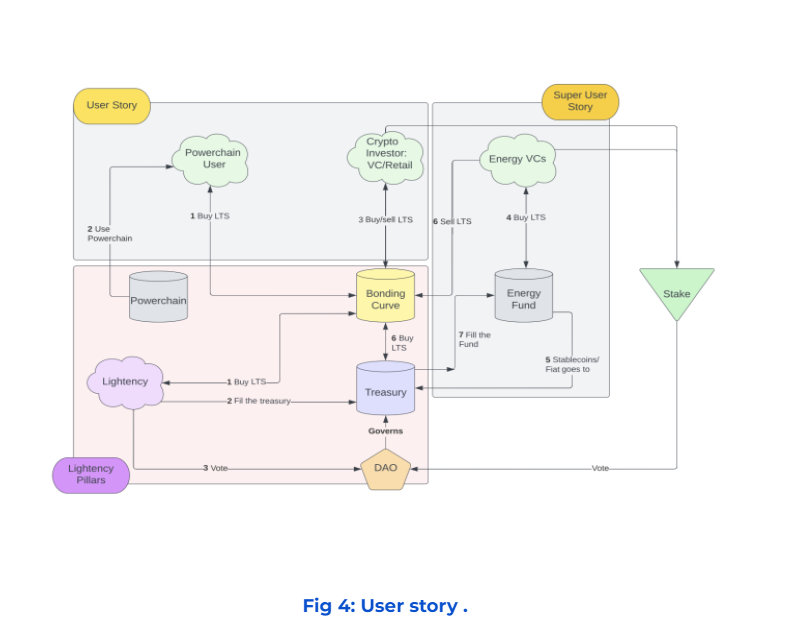
Crypto Investors who look to Medium-long term investment will be able to invest in Green Energy projects through the energy fund as well as earn attractive passive income and participate in LightencyDAO.
-
Yield Farmers/ Crypto VCs/ Retail Investor :
Crypto enthusiasts looking to generate attractive returns while making a green impact
-
Vesters :
Crypto enthusiasts looking for exclusive packs while locking tokens for a considerable period
-
Organisations :
Any Organization that is looking to use the energy certification platform to certify green energy production, or to buy and sell a green energy certificate.
-
Utilities & DSO* :
*DSO : are the entities responsible for distributing and managing energy from the generation sources to the final consumers Typically.
Energy distributors who have interest to incentivise their customers to produce local green energy. PowerChain allows an energy marketplace where local producers can provide their energy exceedance in a local community marketplace.
Token model
Bonding curve
-
How does it work? :
A bonding curve contract issues its own tokens through buy and sell functions. To buy tokens, you send cryptos/fiat to the contract which swaps these assets to stable coins and issues Lightency tokens following the value of the cryptos/fiat received.[2]
-
The Sell function works in reverse:
First you provide the bonding contract with permission to take the amount of tokens you want to sell and then you trigger the function to take those tokens from you. The contract will calculate the current average selling price and will send you the correct amount and burn the tokens sold. Token price is then updated following its relation with the token supply.
Advantages Disadvantages The advantage of the bonding curve is that it ensures organic growth. Indeed, the price of the token only increases according to the increase in demand. This prevents us from phases of speculative bubbles, leading in most cases to extreme volatility. The disadvantage of the bonding curve is that it allows for printing and burning to occur forever, they allow for supply to grow without bounds Mitigation: Alternatively, some bonding curves hard-code a cap to the number of prints that can exist in the market. Hard coding a hard cap to no longer have the supply infinity constraint will ensure that the price of the token does not become stationary. Once the hard cap is reached, the token will then trade in the secondary market.The advantage with the reward system is that the dilution of the token's value is almost non-existent, and given the deterministic nature of the token's price, Lightency can estimate the price impact of the reward distribution. A disadvantage of the bonding curve, it flows from its nature, namely that each token is a standard of value. Rewards can only be distributed by collecting part of the profits generated from the activity within the Lightency ecosystem. Mitigation: Using an augmented Bonding Curve (ABC) allows implementing vesting mechanisms. Dedicating initial funds to buy tokens to charge the reward and incentive pools.
Price
The Price per token increases as the number of tokens issued increase.


What happens if the price in the secondary market is different from the price on the Bonding Curve?
Arbitrage
Source : Click here
Lightency pillars
The treasury


Energy fund pool
User / System experience
Staking

Lightency DAOs
To browse more detailed documenation, clik on the : Lightency DAOs
Roles
-
Council :
Council members are whitelisted members.They are the most superior in the hierarchy . Only council members can add other council members . Council members are also the only members that can create a proposal. Council members can vote on proposals.
-
Community :
Community Members are the new joiner to the DAO only at one condition they must be stakers . Only stakers can join a DAO and become a community member. Community members can vote on the proposals listed by counsel members.
Proposals
The Proposals can be one of these types :
-
Fund a Specific Pool :
By specifying in the proposal the address of the pool that we want to fund
-
Burrow :
Burrow Stable coins from lending protocols.
-
Delete a Member :
A council member can create a proposal to delete a council member.
-
Community Pool :
is to decide on upcoming features, updates, and any strategic decision that can impact the economy of the token.

Energy Attribute Certification

DAO oriented
Solution
Powerchain

Powerchain
-
Description :
The EMS has the role of maximizing the efficiency of the MG and optimizing the distribution of available production on the grid. This system communicates, in real time, with devices and services to collect data, perform analyzes and calculations, and execute control and processing algorithms. In other words, the EMS manages the energy flow in such a way to keep the entire network in balance. In order to do so, the system has to be in continuous communication with the devices and the available services on the grid. This requires that it implements multiple communication protocols in order to ensure interoperability.
-
Architecture :
The EMS is composed of a central node and a local node. The local EMS is directly connected to the devices (e.g. production system, meters, storage system, etc.), it monitors the system, collects data and executes control commands. The central component manages and optimizes the energy flow of the entire network by communicating with the decentralized local EMS. It provides data aggregation, monitoring and visualization of local components. Each component has its own user interface adapted to the specific needs of the user (prosumers for local EMS, network manager for central EMS). The interface should display real-time network data and status.
